

How Do Generalization And Discrimination Help People And Animals Adapt To Their Enviroments
A dog who jumped at the sound of a heavy box falling to the floor can become frightened by other sudden noises downwardly the route. A domestic dog who has had many different positive interactions with children will come to learn the presence of kids ways expert things happen.Scientifically, that phenomenon is called stimulus generalization. Generalization is the tendency for learned behavior to occur in the presence of stimulus that is similar but not identical to the learned stimulus. (Stimulus is defined as events that have a measurable effect on beliefs.)
 Every bit humans, we're pretty nifty at generalization. A child who was bitten by a bird may become afraid of all birds. When nosotros learn how to tie a shoe, we can tie whatsoever shoe nosotros wear. If we were given a hefty fine by a law officer in a auto with its lights flashing, we will probably flinch adjacent time a police auto with lights flashing is backside united states.
Discrimination on the other hand is the tendency for a learned behavior to occur in 1 situation, only non in others. A child may exist afraid of a dog when in an enclosed yard just non on a playground. A child may scream when he falls only in the presence of one of his parents.
How does this chronicle to grooming?
As for generalization to aversive stimulus, it's of import to recognize that fears can generalize. A dog who was scared by a mailman tin can later on develop fearful responses to policemen, or other uniformed men. It is important to teach your dog a new, positive association with its initial fear elicitor as shortly as possible.
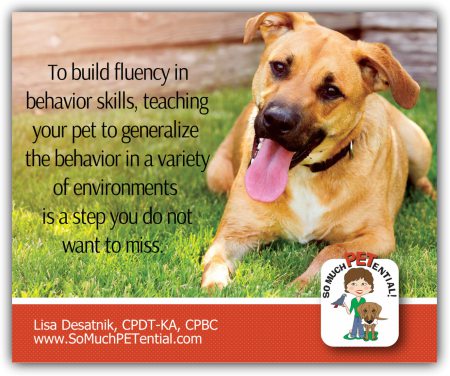
On the flip side, information technology is of import to keep in heed that to build fluency in a behavior skills, pedagogy your pet to generalize the behavior in a diverseness of environments is a step you don't want to miss. And, with the exception of aversives, dogs are great discriminators. (No, teaching him to stay off of a couch in the family room does not hateful he understands to stay off of the couch in the fancy living room.)
However, there is a lot more just changing the environs to keep in heed.
Hither are just a few tips:
Practice asking for the behavior in dissimilar positions to you. Yous may desire to enquire your dog to sit when yous are in front of him or backside him; or when you are sitting, standing, or running; when yous next to your pet or five anxiety abroad (calculation distance very slowly only when you are still having success).
When your pet is reliably doing the beliefs when cued, practice having other people give your pet his cue.
Practice by gradually increasing distractions (only increasing criteria when yous are still having success).
Hither is some additional good news about spending the time pedagogy your pet to generalize: One time he has learned to generalize a few behaviors, he volition first to generalize other behaviors besides with much greater ease.
Can I be of further help to you and your pet? Please contact me!
If this is helpful to you, please consider sharing it.
Source: https://somuchpetential.com/generalization-and-discrimination-in-dog-and-other-pet-training/
Posted by: ludwiglikeriatues.blogspot.com
0 Response to "How Do Generalization And Discrimination Help People And Animals Adapt To Their Enviroments"
Post a Comment