

What Animal Combinations Haft To Be Artificially Made
Abstruse
Have you ever heard of ligers and tigons-mixes between lions and tigers? Wolfdogs, a mix between wolves and dogs? Or maybe a grolar, a grizzly and polar bear mix? When organisms from two different species mix, or breed together, it is known as hybridization. The offspring that are produced from these mixes are known every bit hybrids. Hybrids occur in the natural earth and are a powerful evolutionary force. They are likewise of import in our daily lives—you probably consume hybrid plants every day. In this commodity, we dive into the exciting world of hybridization, describing how information technology occurs and what tin can happen when hybrids take babies.
What Is a Species?
Hybridization is breeding of two different species [1]. So, for us to look into the world of hybridization, first we must understand what a species is. Organisms that are the aforementioned species are more than similar to each other than to organisms from unlike species. It is easy to tell some species apart, for example a hippopotamus is recognizably a different species from a cheetah (come across Effigy 1). But what is the difference between a cheetah and a leopard? They are also different species, just a leopard looks very similar to a chetah. Both live in Africa, are carnivores, cats, and both even have spots. The near commonly used rules to dissever organisms into species are called the Biological Species Concept [two]. These rules consider animals to be dissimilar species if they cannot breed together or if they breed together and produce infertile offspring, meaning offspring that cannot take their own babies. Because a cheetah and a leopard cannot breed together, nosotros consider them two unlike species. Other rules that separate like animals or plants into different species are controversial. Some scientists look for physical differences, for example, differences in pecker shape, torso colour, beliefs, habitat, or geographical location. Other scientists use differences in genes to aid find unlike species. Every living organism has genes, which are independent in the DNA and hold the data that tells the body how to work. Within a species, in that location will be small differences within genes called mutations. Such mutations are what cause slight differences within a species, like different eye colors in humans. Mutations even decide whether yous can curlicue your natural language or not! Between species, in that location are far more than mutations between genes. It is mutations that cause the differences in pecker size or behavior that nosotros encounter. If scientists are not sure if two organisms are unlike species, they can compare and count the mutations, to bank check.
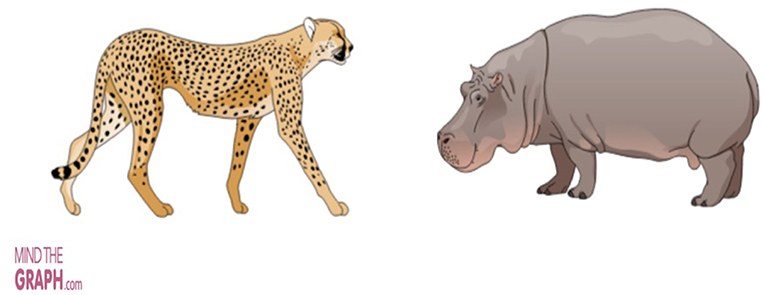
- Figure i - A chetah and a hippopotamus are ii different species.
- Both alive on the African continent, but hippopotamuses live in water and marshy areas, while cheetahs hate beingness moisture and live on the African grasslands. A hippopotamus is a herbivore and a chetah is a carnivore. The ii species cannot hybridize.
What Are Hybrids?
When two animals of the aforementioned species mate, their offspring become 50% of their genes from each parent. This is what makes you expect like a mixture of your parents. Hybrids are crosses betwixt 2 divergence species, so they contain l% of genes from each parent species [1]. A famous hybrid is the mule, a cantankerous between a ass and a horse. L per centum of a mule's genes are from a horse and fifty% from a donkey. Considering of this mixing, mules have features of each parent species and are strong, like donkeys, as well equally intelligent, like horses [iii]. Farmers breed mules considering this combination makes mules excellent for conveying supplies. Using hybridization to combine the desirable aspects of each parent species is very beneficial to humans, and hybrids are oftentimes used in farming. Many of the delicious fruits y'all buy at the grocery store were even created through hybridization! Bananas, grapefruit, carrots, and cucumbers are all hybrid species. There are actually hundreds of assistant varieties, only most of usa are familiar with a hybrid banana. Farmers kept mixing varieties of bananas to create the perfect combination of soft, tasty fruit without too many seeds [4].
Tin Hybrids Have Babies?
Mules and bananas are examples of hybrids that are infertile, so they cannot have their own babies. But surprisingly, there are many examples of hybrids that actually tin have babies. This happens when the hybrid mates with another hybrid, or with the same species as i of its parents. For example, when lions and tigers hybridize they produce a liger. Ligers are fertile and can mate with other ligers, lions, or tigers. Fertile hybrids create a very complex problem in science, because this breaks a rule from the Biological Species Concept—that two separate species should non be able to breed and have fertile offspring. Does this hateful the parents of these fertile hybrids are not divide species? No, it just means that the Biological Species Concept is not suitable for every species. Thank you to the discovery that some hybrids are fertile, scientists proceed to contend what a species is and probably will do so for many years. This is what makes hybridization is and so interesting—it challenges some of our basic scientific ideas [1].
When hybrids mate with either of their parent species, their offspring are known as backcrossed hybrids [1]. In Figures 2A,B, nosotros see a liger, a hybrid betwixt a lion and tiger that has mated with a tiger. The baby from this mix, the backcrossed hybrid, still has some lion genes. If backcrossing continues for many generations (the backcrossed hybrid mates with a tiger, and so its offspring does the same) the per centum of lion genes will get smaller and smaller, but they are not lost completely. This means that lion genes tin can eventually get part of the tiger species' gene puddle. When ane species contains some of the genes of another species, it is known as introgression. This is a powerful evolutionary force, considering these new genes may lawmaking for new traits or behaviors that could help the parent species [5].
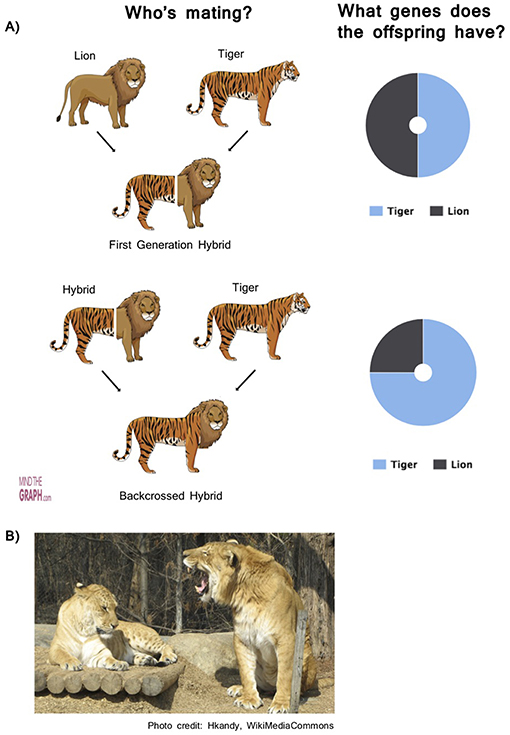
- Figure ii - (A) On the top left, a lion and a tiger mate to produce a hybrid.
- This king of beasts-tiger hybrid has 50% of its genes from the panthera leo and fifty% from the tiger. If the hybrid then mates with a tiger (lesser left), that offspring, called a backcrossed hybrid, volition have lower percentage of panthera leo genes. (A) Is a drawing, and in reality, ligers, and tigons are mixed all over their bodies as nosotros run into in (B). Which is an example of two ligers living in a zoo.
What Bear on Does Hybridization Have on the Natural World?
So far, we have only spoken near hybrids created by humans. Lions and tiger never see naturally in the wild, merely other hybrids exercise occur naturally. In fact, there are hundreds of hybrids in the natural world. Information technology is thought that ane in four plant species, and one in ten animal species, hybridize [6]. Hybridization can assistance parental species by transferring new genes, through introgression, and can even lead to the cosmos of new species [5]. For example, South American Heliconius butterflies have gained role of their cute wing patterns through hybridization (Figure 3) [7]. Heliconius butterflies use their wing patterns to attract mates, as well as to avoid predators, who interpret the patterns as alarm signals. [seven]. Aboriginal hybridization of sunflower species has besides generated new species in North America. These hybrid-origin sunflowers tin can live in more farthermost environments, where the soil is poor or toxic. Hybridization combined traits of the two parent species, forming a new factor combination in the hybrid that enabled it to live in this new habitat [8].
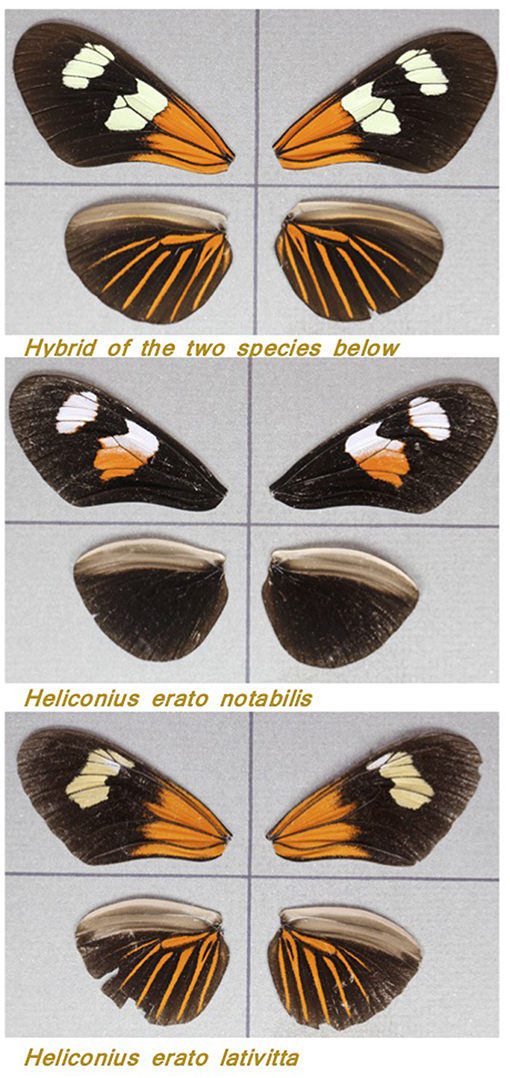
- Effigy 3 - Wings of three Heliconious butterflies.
- The elevation panel shows a hybrid of the two butterfly species in the panels beneath it, so the hybrid's wing patterns are a mixture of the ii parents. This hybridization can be advantageous, because the new wing patterns may concenter mates, but information technology can as well exist disadvantageous, because some wing patterns can make butterflies more obvious to predators. Pictures are from heliconius.ecdb.io.
Although many of the natural hybrids we accept spoken about are from modern species, in that location are also examples of ancient hybridizations that happened tens of thousands of years ago. These hybrids can be identified even when the parental species are extinct. This is because some of the parent species genes will even so be present in a pocket-size percentage in the hybrid. By comparing gene mutations betwixt closely related species, nosotros tin can find potential hybrids by looking for genes that are very different, or mutations that accept come up from one of the ancient hybrid's parent species. Using this method, an ancient hybrid was found to exist an ancestor to many species of clownfish (like Nemo from Finding Nemo). Simply like the sunflower, the combination of adaptations in this aboriginal hybrid allowed the clownfish ancestor to alive in a new habitat [9]. As a issue, this ancient hybrid is an antecedent to many modern clownfish species.
Sometimes hybrids can be bad for the parental species and for the natural world. If hybrids are very successful, there may be so many hybrids that they compete with their parent species for food and living space, which could lead to the extinction of the parent species. Losing a species is bad for biodiversity and can affect other species in that habitat. When this species loss occurs naturally, scientists do not try to cease it, because it is a natural process. Loss of a parent species due to hybrid offspring is only problematic when the hybrid is created by humans and introduced to an area where the parent species were not naturally found. We must act to forbid the extinction of the parent species in these cases. But exercise non worry, the hybrids that we buy at the grocery shop are unlikely to cause astringent environmental harm, because at that place are rules in identify to make sure they are grown with peachy care.
Decision
Hybridization is a complex process involving the mixing of two species. Hybridization is an of import part of evolution, due to the transfer of genes through introgression and its role in the generation of new species. It is also function of our daily lives and is used to help better foods and livestock.
Glossary
Hybridization: ↑ Breeding between two unlike species.
Species: ↑ Organisms that are similar to each other and tin can brood together to produce fertile offspring. Non all scientists concord on how to ascertain what split species are.
Genes: ↑ Sections of DNA that incorporate the instructions for body processes and characteristics (such as center colour).
Mutations: ↑ Minor differences in genes that make individuals look unique. Lots of mutations occur betwixt species.
Fertile: ↑ Able to reproduce and accept babies. Infertile is the opposite, meaning the inability to have babies.
Introgression: ↑ When the genes from one species are transferred into some other species through hybridization and backcrosses.
Conflict of Interest Statement
The authors declare that the research was conducted in the absence of any commercial or financial relationships that could be construed as a potential conflict of involvement.
References
[one] ↑ Allendorf, F. W., and Liukart, One thousand. (eds.) 2007. "Hybridization," in Conservation and the Genetics of Populations (Malden, MA: Blackwell Pub). 421–48.
[2] ↑ Mayr, E. 2000. "The biological species concept," in Species Concepts and Phylogenetic Theory: A Debate, eds Q. D. Wheeler and R. Meier (New York, NY: Columbia University Press). 17–twenty.
[3] ↑ Proops, L., Burden, F., and Osthaus, B. 2009. Mule knowledge: a case of hybrid vigour? Anim. Cogn. 12:75–84. doi: x.1007/s10071-008-0172-one
[four] ↑ Perrier, X., De Langhe, E., Donohue, M., Lentfer, C., Vrydaghs, L., Bakry, F., et al. 2011. Multidisciplinary perspectives on assistant (Musa spp.) domestication. Proc. Natl. Acad. Sci. United states of americaA. 108:11311–8. doi: ten.1073/pnas.1102001108
[5] ↑ Arnold, M. 50., Sapir, Y., and Martin, N. H. 2008. Genetic substitution and the origin of adaptations: prokaryotes to primates. Philos. Trans. R. Soc. Lond. B Biol. Sci. 363:2813–20. doi: x.1098/rstb.2008.0021
[half dozen] ↑ Mallet, J. 2005. Hybridization as an invasion of the genome. Trends Ecol. Evol. 20:229–37. doi: 10.1016/j.tree.2005.02.010
[7] ↑ Kronforst, 1000. R., Immature, L. G., Blume, L. G., and Gilbert, Fifty. E. 2006. Multilocus analyses of admixture and introgression amongst hybridizing Heliconius butterflies. Development 60:1254–68. doi: 10.1554/06-005.one
[8] ↑ Rieseberg, L. H., Raymond, O., Rosenthal, D. Yard., Lai, Z., Livingstone, K., Nakazato, T., et al. 2003. Major ecological transitions in wild sunflowers facilitated by hybridization. Scientific discipline 301:1211–half-dozen. doi: ten.1126/science.1086949
[9] ↑ Litsios, Yard., and Salamin, N. 2014. Hybridisation and diversification in the adaptive radiation of clownfishes. BMC Evol. Biol. 14:245. doi: 10.1186/s12862-014-0245-5
Source: https://kids.frontiersin.org/articles/10.3389/frym.2019.00113
Posted by: ludwiglikeriatues.blogspot.com
0 Response to "What Animal Combinations Haft To Be Artificially Made"
Post a Comment